The Ripple Effects of Tournament Structures on Community Engagement Metrics Within Digital Card Game Networks
Written by Anna Simmons · Jul 20, 2026
The Ripple Effects of Tournament Structures on Community Engagement Metrics Within Digital Card Game Networks
Digital card game networks have expanded rapidly since the early 2020s, with platforms hosting millions of matches each month through structured tournaments that range from open Swiss formats to closed elimination brackets. These structures shape participation patterns because single-elimination events often concentrate activity into shorter bursts while round-robin or league-style formats spread engagement across multiple weeks. Data collected from major titles such as Magic: The Gathering Arena and Yu-Gi-Oh! Master Duel show measurable differences in daily active users and session lengths depending on the chosen format.
How Bracket Designs Influence Retention and Repeat Play
Swiss system tournaments allow players to continue competing even after a loss, which correlates with higher retention rates across weekly cycles. Observers note that participants in these events log back in more consistently to track standings and complete remaining rounds, whereas pure elimination brackets tend to produce sharp spikes followed by drops once players exit early. Research from the Interactive Software Federation of Europe indicates that networks using hybrid formats, combining Swiss qualifiers with final elimination stages, maintain steadier month-over-month user retention compared to single-format seasons. The distribution of rewards also plays a role because prize pools allocated across multiple placement tiers encourage broader involvement rather than concentrating attention solely on top competitors.
Community Interaction Patterns Across Different Formats
Round-robin leagues foster repeated matchups between the same players, which in turn builds recognizable rivalries and increases in-game chat volume as well as external forum discussions. Single-elimination events, by contrast, generate high-stakes moments that drive short-term spikes in social media mentions and live stream viewership, yet they produce fewer sustained conversations once brackets conclude. Analysts tracking Discord server activity within digital card game communities have recorded elevated message counts during league seasons, particularly when standings update in real time and players coordinate team strategies or discuss matchup histories. These patterns appear consistently in networks that publish detailed match logs, allowing participants to review and share specific plays.
Geographic and Temporal Variations in Engagement
Time zone alignment affects how tournament schedules translate into global participation. Networks that stagger start times across regions report more balanced login distributions, while those running single global events see concentrated activity from one or two primary time zones. In July 2026 several platforms introduced staggered Swiss qualifiers that opened at regional prime times, resulting in documented increases in cross-region friend requests and team formations. Academic studies published by the University of Melbourne's Digital Games Research Centre have examined these timing effects and found that flexible scheduling correlates with longer average player lifespans within a given network, measured by total matches played over six-month windows.
Measurement of Engagement Metrics and Data Sources
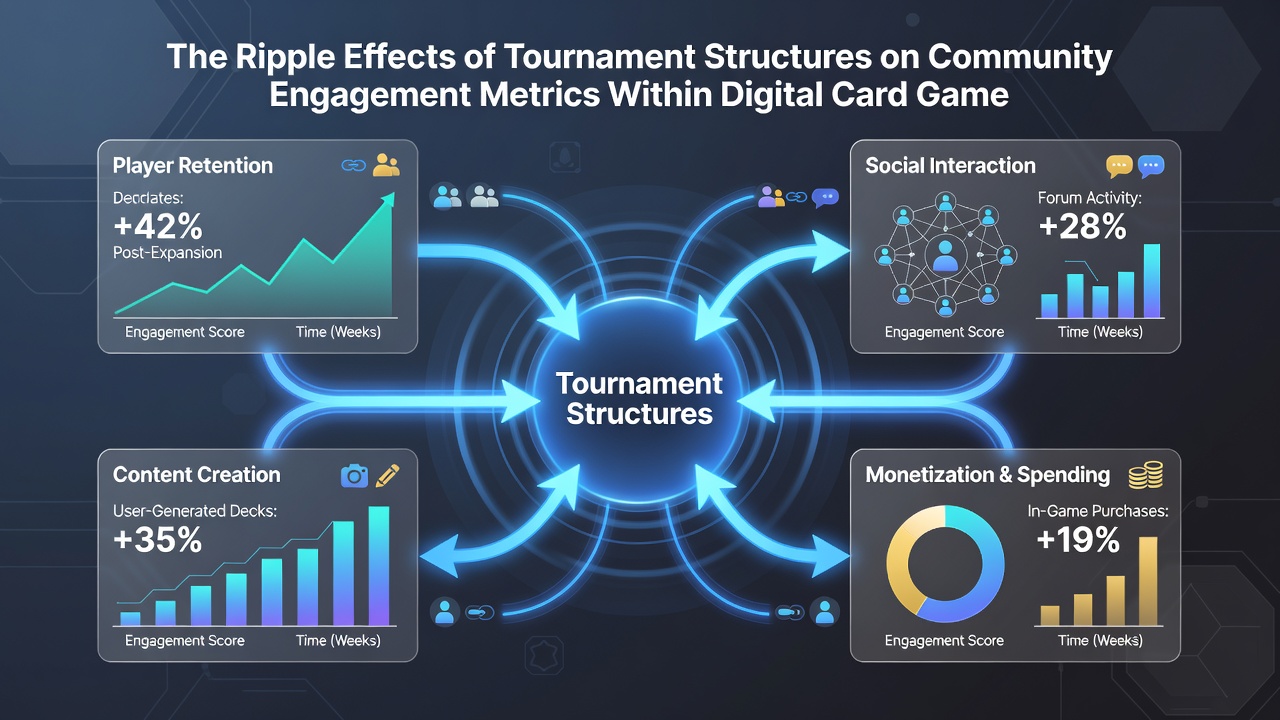
Key metrics tracked by network operators include average matches per user per week, percentage of players returning within seven days of a tournament, and volume of user-generated content such as deck lists or strategy posts tied to ongoing events. Figures released by the Entertainment Software Association of Canada demonstrate that communities with transparent leaderboards and historical performance data sustain higher levels of content creation throughout tournament cycles. Networks that integrate these metrics into public dashboards allow participants to set personal goals, which further extends session times and encourages exploration of different deck archetypes. External observers have also noted that API access granted to third-party analytics tools amplifies visibility of engagement trends, enabling researchers to correlate specific structural choices with behavioral outcomes across multiple titles.
Structural Adjustments and Their Observed Outcomes
When operators shift from open registration to seeded brackets based on prior performance, the distribution of matches changes noticeably. Lower-seeded players encounter a wider variety of opponents early, which some studies link to increased experimentation with card combinations. At the same time, top-seeded competitors face longer average match durations because both sides optimize lineups more carefully. Data from North American and Australian server logs indicate that such seeding adjustments produce modest but consistent lifts in overall match completion rates without reducing total unique participants. Networks that publish post-event reports detailing these shifts help players understand format impacts, which in turn supports more informed registration decisions in subsequent cycles.
Conclusion
Tournament structures continue to serve as primary levers for shaping engagement across digital card game networks, with different formats producing distinct patterns in retention, social interaction, and content generation. Ongoing data collection from industry associations and academic institutions provides operators with evidence to refine bracket designs, reward distributions, and scheduling approaches. As platforms evolve through 2026 and beyond, the interplay between these structural elements and measurable community metrics remains central to sustaining active player bases.